Five Images of the Same Star: How 'SN Winny' Could Crack the Cosmic Speedometer
A rare lensed supernova, SN Winny, appears five times due to gravitational lensing. Measuring time delays between images directly yields the universe's expansion rate, potentially resolving the Hubble constant tension.
Astronomers have discovered a rare supernova, nicknamed ‘SN Winny,’ that appears as five separate points of light in the sky. This cosmic trick—created by a phenomenon called gravitational lensing—offers a new way to measure how fast the universe is expanding, a value known as the Hubble constant. By timing the slight delays between each image, scientists can directly calculate this expansion rate, potentially resolving persistent disagreements between different measurement methods. Below, we explore the key questions about this remarkable find.
1. What is SN Winny and why is it so special?
SN Winny is a superluminous supernova—an extraordinarily bright stellar explosion—located about 10 billion light-years away. What makes it one in a million is that it appears five times in the same photograph, arranged in a cross-like pattern around two massive foreground galaxies. This multiple imaging is caused by gravitational lensing, where the gravity of the foreground galaxies bends and splits the light from the supernova like a cosmic magnifying glass. Each image shows the same explosion but at slightly different moments in time, because the light follows paths of different lengths around the gravitational lenses. For astronomers, SN Winny is a natural time machine that captures five stages of the same event.
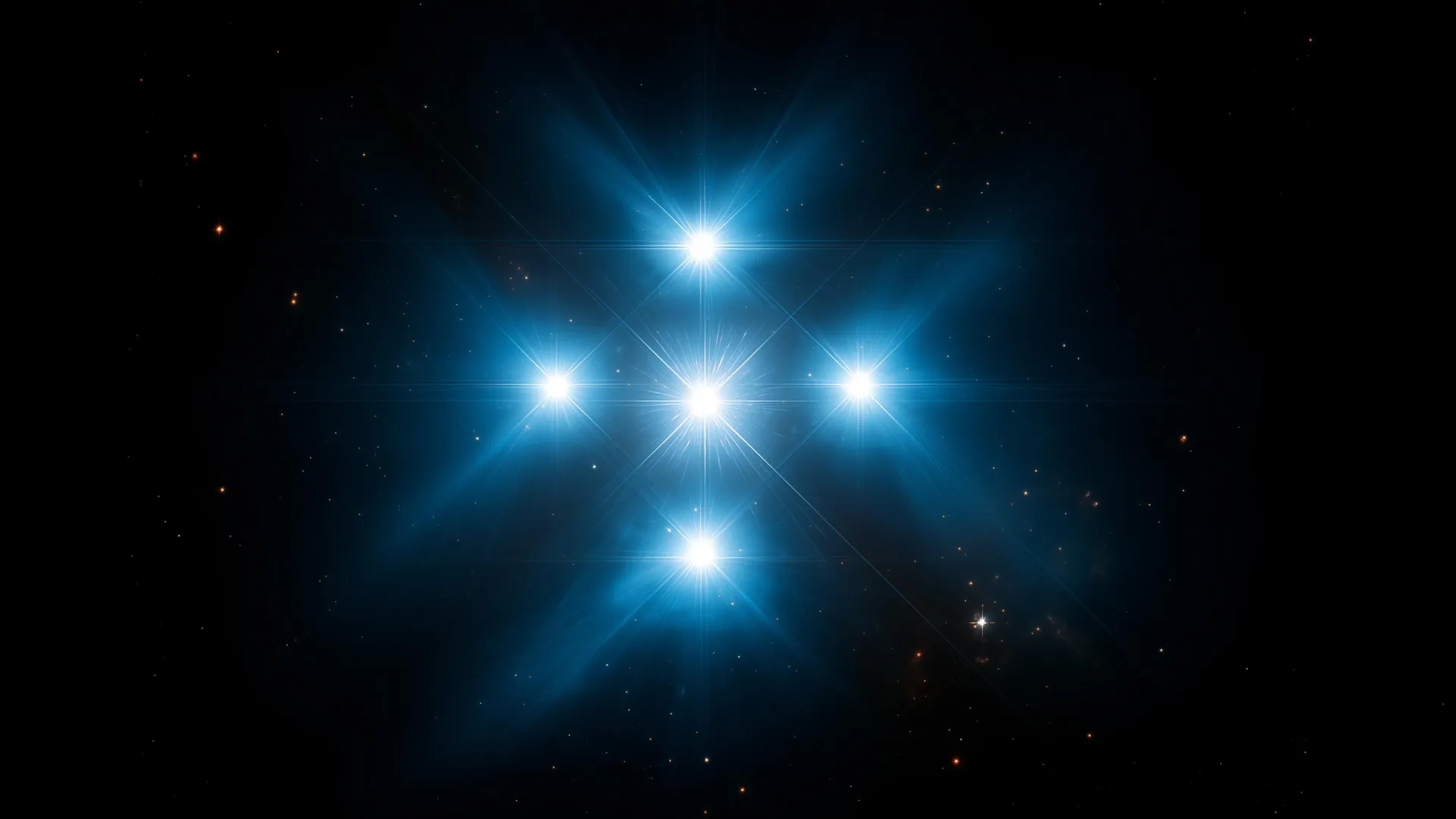
2. How does gravitational lensing create five images of the same supernova?
Gravitational lensing occurs when a massive object—such as a galaxy cluster or two galaxies—bends the fabric of space-time around it. Light from a distant source, like SN Winny, passes through this warped space and takes multiple routes to Earth, just as light through a glass lens can form multiple images. In this case, two foreground galaxies act as the lens, producing a rare configuration that yields five distinct images of the supernova. Because the lens is not perfectly symmetrical, the paths differ in length, so the same flash of light arrives at our telescopes at different times—ranging from hours to weeks apart. This time delay is the key that unlocks new measurements.
3. How can the delay between images reveal the universe's expansion rate?
By precisely measuring the time delays between the five images of SN Winny, astronomers can calculate the distance the light traveled along each path. The delays depend on two factors: the geometry of the gravitational lens (the masses and positions of the foreground galaxies) and the overall expansion of the universe. If the universe expands faster, the distances change, altering the delays. With a well-modeled lens, scientists can thus directly infer the Hubble constant—the current expansion rate. This method does not rely on a cosmic distance ladder, offering a clean, independent check on other techniques. Early analyses of SN Winny suggest it can yield a Hubble constant value with uncertainty as low as 2–3 percent.
4. Why is measuring the Hubble constant so important?
The Hubble constant (H₀) describes the current rate of expansion of the universe. It is fundamental to cosmology, because it sets the scale for the universe’s size, age, and fate. However, different measurement methods disagree: measurements from the early universe (using the cosmic microwave background) give a value of about 67 km/s/Mpc, while measurements from the local universe (using supernovae and Cepheid variable stars) yield about 73 km/s/Mpc. This tension hints at either new physics or hidden errors. SN Winny offers a third, independent way—using gravitational lensing time delays—that could resolve this debate. If its result aligns with one side, it may confirm that we are missing something in our standard model of cosmology.
5. What advantages does this method have over previous techniques?
Unlike traditional methods that rely on a cosmic distance ladder (building from nearby stars to distant galaxies), the gravitational lensing time-delay method is single-step and geometric. It directly links the time delays to the expansion rate, without needing to calibrate intermediate rungs. The superluminous nature of SN Winny also makes it easier to observe despite being 10 billion light-years away—its brightness allows precise timing even though each image is faint. Moreover, because the supernova appears multiple times, astronomers can cross-check the measurements. This technique has been used before with lensed quasars, but supernovae vary quickly, providing sharper time-delay signals. SN Winny is the first lensed superluminous supernova, offering a clean, high-precision test.
6. Are there any challenges or limitations to this approach?
Yes, several challenges remain. First, modeling the gravitational lens is complex—the two foreground galaxies have their own mass distributions, and dark matter may be clumpy, introducing uncertainties. Second, the supernova’s light curve must be carefully tracked to match each image to the same explosion event and measure time delays accurately. Third, SN Winny is extremely distant, so observations require powerful telescopes like the Hubble Space Telescope and upcoming space observatories. Finally, this is only one object; multiple such lenses are needed to confirm the result. However, new surveys (like the Rubin Observatory) are expected to find dozens more lensed supernovae, turning this rare event into a routine cosmological tool.