Mastering Python's deque for High-Performance Sliding Windows
Learn why Python's collections.deque outperforms lists for sliding windows, thread-safe queues, and real-time data streams. Discover O(1) left-side operations, maxlen, and advanced use cases.
Python's collections.deque is a hidden gem for handling real-time data streams, sliding windows, and thread-safe queues—far outperforming lists for these tasks. In this Q&A, we’ll explore why deque is your go-to tool for efficient, modern Python applications.
What Exactly Is a deque and How Is It Different from a List?
A deque (double-ended queue) is a data structure from the collections module that supports fast O(1) appends and pops from both ends. Unlike lists, which are contiguous arrays, deques are implemented as a doubly-linked list of memory blocks. This makes them ideal for scenarios where you need to frequently add or remove elements from the left side—something that costs O(n) with lists due to element shifting. In short, deque is optimized for operations at both ends, while lists shine for random access in the middle.

Why Should You Avoid Using Lists for Sliding Windows?
When building a sliding window—say, tracking the last N sensor readings—you often remove the oldest item and add a new one. Using a list, pop(0) or del window[0] forces Python to shift every remaining element one position left, which is O(n). For large windows or high-frequency updates, this overhead kills performance. With deque, popleft() is O(1), so even with millions of updates, your window stays lightning fast. Additionally, deque provides built-in rotation and slicing via deque.rotate() and deque.maxlen, simplifying sliding window logic without manual indexing.
How Can deque Implement a Real-Time Sliding Window Efficiently?
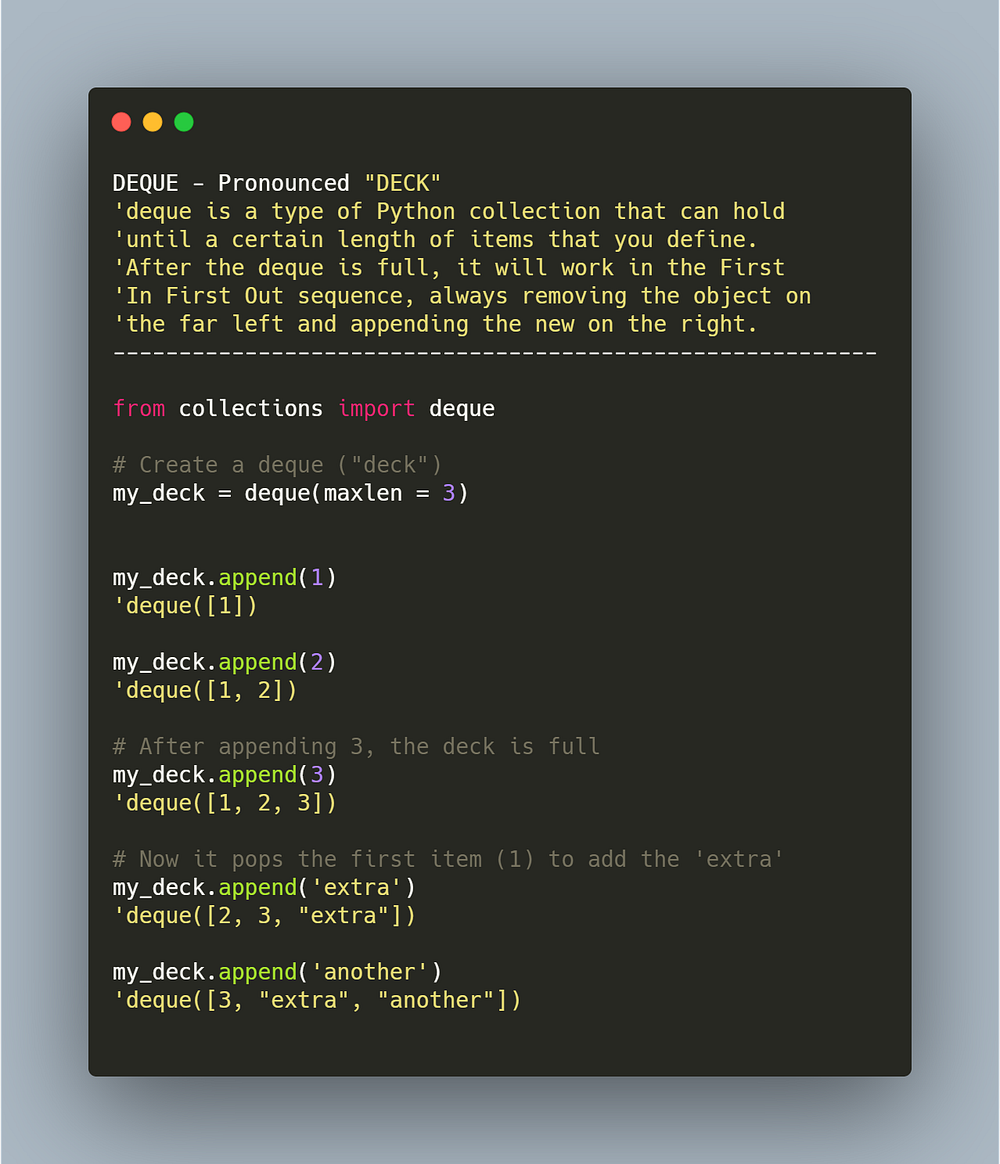
Consider a live stock-price monitoring system where you need the moving average of the last 100 ticks. Initialize dq = deque(maxlen=100). Each time a new price arrives, just call dq.append(price). The deque automatically discards the oldest entry when it exceeds 100 elements. Computing the average is then a simple sum(dq) / len(dq) or use numpy for faster processing. No manual index tracking, no shifting—just clean, O(1) append/popleft operations. This pattern scales perfectly to thousands of concurrent streams, making deque ideal for IoT, gaming, and financial dashboards.
Is deque Thread-Safe? Can It Replace queue.Queue?
Yes, deque is thread-safe for atomic append and popleft thanks to Python’s Global Interpreter Lock (GIL). However, compound operations like pop() followed by append() (e.g., for a sliding window) are not atomic and can lead to race conditions. For pure producer-consumer patterns where you need blocking behavior, use queue.Queue which wraps deque with locks and timeouts. But for single-consumer sliding windows or thread-safe appends from multiple producers, deque alone is often sufficient and faster due to less lock overhead.
What Performance Gains Can You Expect When Switching from List to deque?
Benchmarks show deque can be 10–100x faster than lists for left-side operations. For example, adding 1 million items to a list with insert(0, item) takes over a second, while deque’s appendleft() finishes in milliseconds. Even for right-side operations (pop() vs pop()), deque matches list performance. The real win is in sliding windows: removing the oldest element costs O(n) for lists but O(1) for deque. Over a thousand updates, that’s a savings of ~500,000 element shifts. Memory overhead is also lower because deque pre-allocates fixed-size blocks rather than resizing an underlying array.
What Are Some Advanced Use Cases for deque in Data Streams?
Beyond basic sliding windows, deque excels in circular buffers, real-time anomaly detection, and undo/redo mechanisms. For instance, you can maintain a history of recent events with deque(maxlen=N) and rotate through them. In audio processing, a deque can store overlapping windows for FFT analysis. It’s also used in websocket message buffering where recent messages must be kept for retransmission. The rotate() method even lets you implement efficient queue reordering—for example, promoting an element to the front in O(1).
Summary: When Should You Reach for deque Instead of a List?
Use deque when you need:
- Frequent append/pop from left side
- A bounded sliding window (use
maxlen) - Thread-safe appends/pops (single consumer)
- Efficient circular buffer behavior
Use a list when you need random access by index (deque is O(n) for middle elements) or when all operations are only on the right side. For most real-time streaming tasks, deque is the silent performance booster you didn’t know you needed.